Introduction
If you want to rank website on Google in 2026, you need more than just writing random blogs and adding a few keywords. Google’s ranking system has become smarter, more competitive, and more focused on user experience than ever before.
In today’s SEO world, ranking is not just about putting the right keyword in your content. It’s about building a complete system that helps Google trust your website, understand your content, and show your pages to the right audience.
As the founder of Bluecuts Web Developers and Digital Marketing Agency, I’ve spent 10+ years working with businesses across real estate, hospitality, healthcare, and B2B services. One thing is clear: websites don’t rank because of luck – they rank because of structure, consistency, and strategy.
In this blog, I will break down the exact step-by-step SEO ranking blueprint you need to follow if your goal is to rank higher on Google and build long-term traffic.
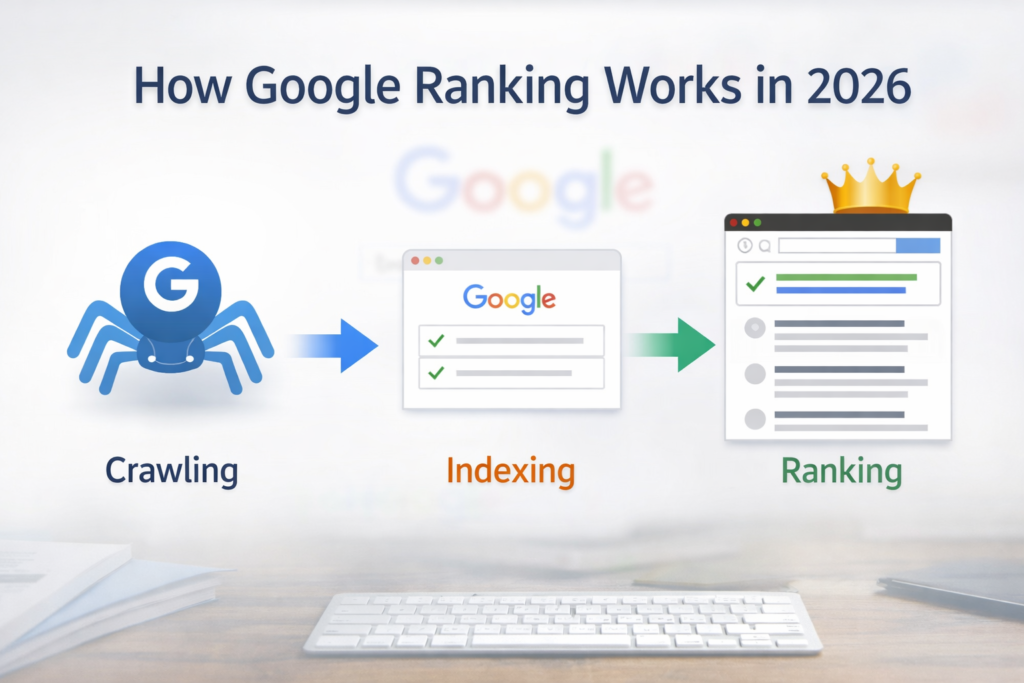
How Google Ranking Works in 2026
Before you start improving rankings, you must understand how Google decides which website deserves page 1.
Google uses thousands of signals, but the core ranking system in 2026 is based on these key pillars:
- Search intent matching
- Content relevance
- Trust and authority
- Technical SEO performance
- User experience (UX)
- Backlinks and mentions
- Engagement and behavior signals
If your website performs well across these areas, your rankings will naturally improve.
Search Intent and Relevance (Most Important Ranking Factor)
Google does not rank websites based on keywords alone.
It ranks websites based on search intent.
Search intent means:
What does the user actually want when they type a keyword?
Example:
- Keyword: “SEO agency”
Intent: looking for a service provider - Keyword: “how to rank a website on Google”
Intent: wants a step-by-step guide - Keyword: “SEO checklist 2026 PDF”
Intent: wants a downloadable checklist
If your page does not satisfy the intent, Google will push your page down, even if your content is long.
That’s why ranking blogs in 2026 must be written with clarity, structure, and user value.
E-E-A-T and Trust Signals
Google’s E-E-A-T framework is one of the biggest ranking signals in 2026.
E-E-A-T stands for:
- Experience
- Expertise
- Authoritativeness
- Trustworthiness
Google wants to rank content that is written by real experts, based on real experience, and backed by credible sources.
That’s why you should build:
- an About page
- author bio
- service pages
- client portfolio
- case studies
- contact information
- testimonials
When your website looks like a real business and not a random blog site, ranking becomes easier.
Step 1: Fix Technical SEO First (Before Anything Else)
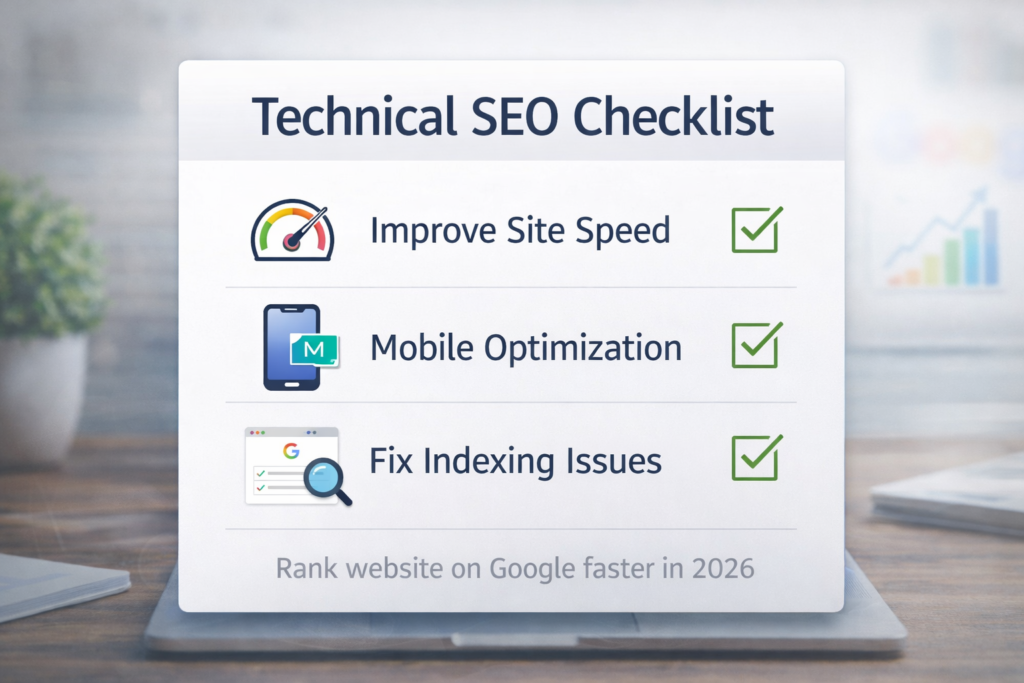
If technical SEO is weak, your website will struggle to rank, even if your content is amazing.
Technical SEO is the foundation.
At Bluecuts, whenever we work on SEO, we first start with a technical audit.
Indexing and Crawlability
Here’s what you should check immediately:
Check if your website is indexed
Search on Google:
site:bluecutsmarketing.com
If your pages show up, indexing is working.
If not, your site has an indexing issue.
Key Technical Fixes for Crawlability
- Submit sitemap in Google Search Console
- Ensure robots.txt is not blocking important pages
- Fix broken links and 404 pages
- Avoid duplicate pages
- Use canonical tags correctly
- Ensure proper internal linking
- Remove “noindex” tags from key pages
Tool to use:
- Google Search Console (free)
Site Speed and Core Web Vitals
Website speed is one of the most powerful ranking signals.
In 2026, people don’t wait.
If your website takes more than 3 seconds to load, your visitors will leave, and Google will notice that.
Google measures performance using Core Web Vitals:
- LCP (Largest Contentful Paint)
- INP (Interaction to Next Paint)
- CLS (Cumulative Layout Shift)
How to Improve Site Speed
Compress images (WebP format)
Use caching plugin
Use a CDN (Cloudflare recommended)
Reduce unused JavaScript
Remove heavy animations
Optimize WordPress database
Use lightweight themes
Mobile-First SEO (Ranking Depends on It)
Google ranks your website based on the mobile version first.
If your mobile design is slow, messy, or unresponsive, your rankings will drop.
Mobile SEO Checklist
- responsive layout
- readable fonts
- fast-loading pages
- clickable buttons
- clean menus
- simple contact forms
A professional UI/UX directly impacts SEO ranking.
Step 2: Keyword Research That Actually Helps Ranking
Keyword research is the backbone of ranking.
Most people fail because they target keywords that are either:
- too competitive
- too broad
- irrelevant
- not searched by buyers
To rank in 2026, your keyword strategy must include both:
- traffic keywords
- conversion keywords
Short-Tail vs Long-Tail Keywords
Short-tail keywords:
- SEO
- web development
- digital marketing
These have high search volume but extreme competition.
Long-tail keywords:
- how to rank a website on Google in 2026
- SEO ranking checklist for small business
- local SEO tips for restaurants
- best SEO strategy for real estate agents
Long-tail keywords bring:
faster ranking
better leads
higher conversions
Buyer Intent Keywords (Ranking + Leads)
If your goal is business growth, focus on buyer intent keywords like:
- SEO services in Delhi
- website development agency for doctors
- local SEO company near me
- digital marketing agency for real estate
- technical SEO audit services
These keywords bring people who are ready to buy.
That’s how Bluecuts can rank faster and also generate leads.
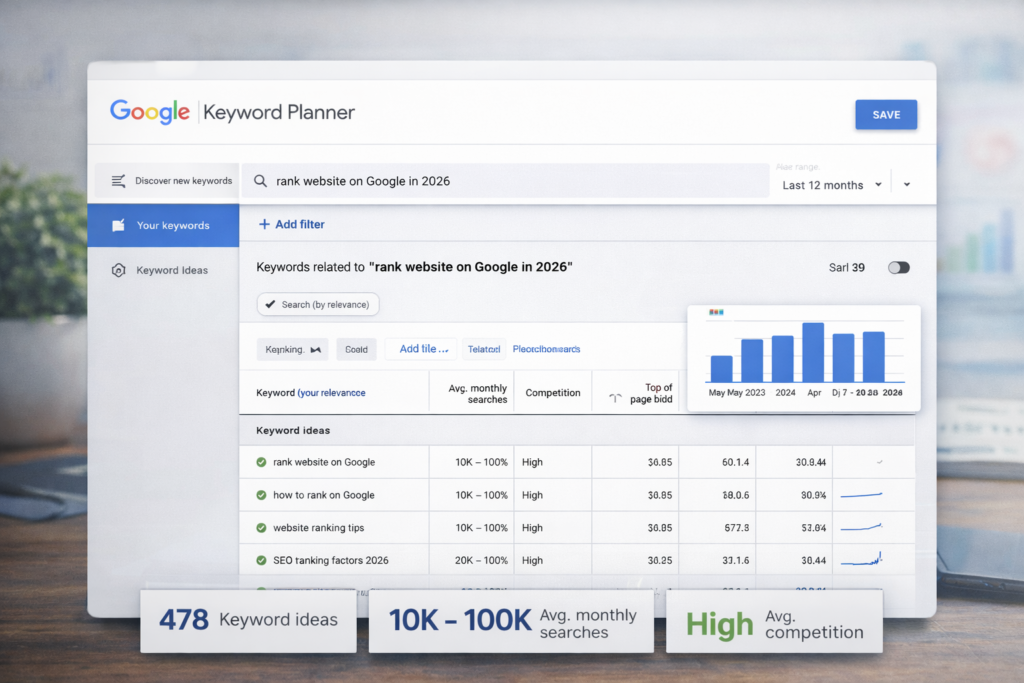
Best Tools for Keyword Research (Google Keyword Planner Included)
To find ranking keywords, you should use:
- Google Keyword Planner
- Google Search Console
- SEMrush / Ahrefs
- Google Trends
- AnswerThePublic
Step 3: Create SEO Content That Google Rewards
Google rewards content that is:
- helpful
- clear
- structured
- up-to-date
- written for humans
- supported with internal links
- supported with external sources
In 2026, SEO content must feel like a complete guide, not a short blog post.
Blog Structure for SEO Ranking
If you want to rank your blog on Google, follow this format:
- H1 Title
- Introduction with keyphrase
- H2 sections for main topics
- H3 sections for detailed points
- Bullet points for clarity
- Images + ALT text
- FAQ section
- Conclusion + CTA
This is exactly how top-ranking pages are structured.
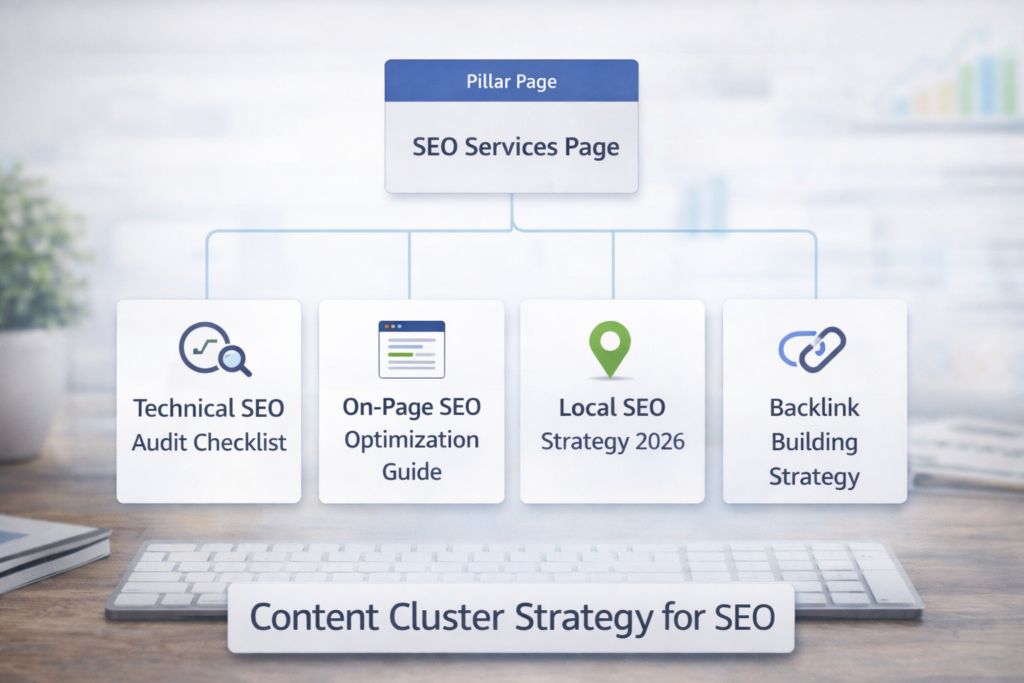
Content Clusters (Best Ranking Strategy in 2026)
Instead of writing random blogs, build clusters.
Example cluster:
Pillar Page:
Supporting Blogs:
- technical SEO audit checklist
- local SEO strategy
- backlink building strategy
- on-page SEO checklist
- SEO tools for business owners
When all these blogs link together, Google sees your website as an authority.
That improves ranking across multiple keywords.
Step 4: On-Page SEO Optimization Checklist
On-page SEO is where you control ranking factors directly.
If on-page SEO is strong, Google understands your content faster.
Title Tags, Meta Description, and Headers
Your title tag must include:
- primary keyword
- benefit-driven hook
- year (2026 adds freshness)
Example:
Rank Website on Google in 2026: Step-by-Step SEO Ranking Guide
Meta description should:
- include keyword
- explain what user will learn
- encourage clicks
Also ensure:
- only one H1 tag
- H2 headings are properly structured
- keywords appear naturally in H2/H3
Image Optimization for Better Ranking
Images help SEO, but only when optimized.
Image SEO Checklist
- use WebP format
- compress file size
- use descriptive filenames
- add ALT text with keywords
- avoid stock photos that look irrelevant
Example filename:
seo-ranking-guide-2026.webp
Example ALT text:
“SEO ranking strategy to rank website on Google in 2026”
Step 5: Backlinks and Authority Building (Ranking Booster)
Backlinks are still one of the strongest ranking factors.
But in 2026, quality matters more than quantity.
Google values links from:
- business sites
- niche blogs
- trusted directories
- high-authority media sites
Guest Posting Strategy
Guest posting is a safe way to build authority.
Steps:
- find blogs in your niche
- pitch valuable topics
- write high-quality content
- add one natural backlink to your website
A few guest posts can significantly improve rankings.
Directory Backlinks (Local Ranking Hack)
Directory listings build trust signals.
Best directories:
- Google Business Profile
- Clutch
- GoodFirms
- JustDial
- Bing Places
- Yelp
These backlinks improve ranking, especially for local SEO.
Step 6: Local SEO to Rank Faster in 2026
Local SEO is the fastest way to rank if you target a city or service area.
If Bluecuts wants to rank in India for SEO and web development services, local SEO must be a priority.
Google Business Profile Optimization
Your Google Business Profile should include:
- correct business name
- keyword-rich description
- service categories
- photos and videos
- posts weekly
- Q&A section
- reviews consistently
A strong profile improves ranking in Google Maps.
Location Pages for Service Businesses
If you want to rank in multiple cities, create location pages like:
- SEO Services in Delhi
- Web Development Services in Gurgaon
- Digital Marketing Services in Noida
Each location page should have:
- unique content
- FAQs
- service list
- testimonials
- CTA button
This is a proven ranking strategy.
Step 7: Track Ranking Progress and Improve Weekly
SEO is not a one-time setup.
Ranking comes from continuous improvement.
Google Search Console Strategy
Google Search Console helps you find:
- keywords you already rank for
- pages with high impressions but low clicks
- ranking opportunities on page 2
The fastest ranking improvement comes from updating pages already getting impressions.
Weekly SEO Improvements Checklist
Every week you should:
- update old blogs
- add internal links
- fix broken links
- improve page speed
- add FAQs
- refresh meta titles
- add new images
SEO ranking improves when Google sees your site as active.
FAQs
How long does it take to rank on Google?
Usually 3–6 months, depending on competition and consistency.
How many blogs are required to rank?
Normally 15–30 blogs are enough to build authority.
Can a new website rank in 3 months?
Yes, with long-tail keywords, technical SEO, and local SEO strategy.
What is the fastest SEO method?
Local SEO + buyer intent keywords + high-quality content updates.
Get a Free SEO Audit Report from Bluecuts
If your website is not ranking on Google, it’s usually because of hidden technical errors, weak on-page SEO, or missing keyword strategy.
At Bluecuts Web Developers and Digital Marketing Agency, we offer a Free SEO Audit Report that includes:
Keyword ranking opportunities
Technical SEO errors
Core Web Vitals report
On-page SEO improvements
Backlink analysis
Local SEO ranking checklist
Want your free report?
Contact us here: https://bluecutsmarketing.com/contact/